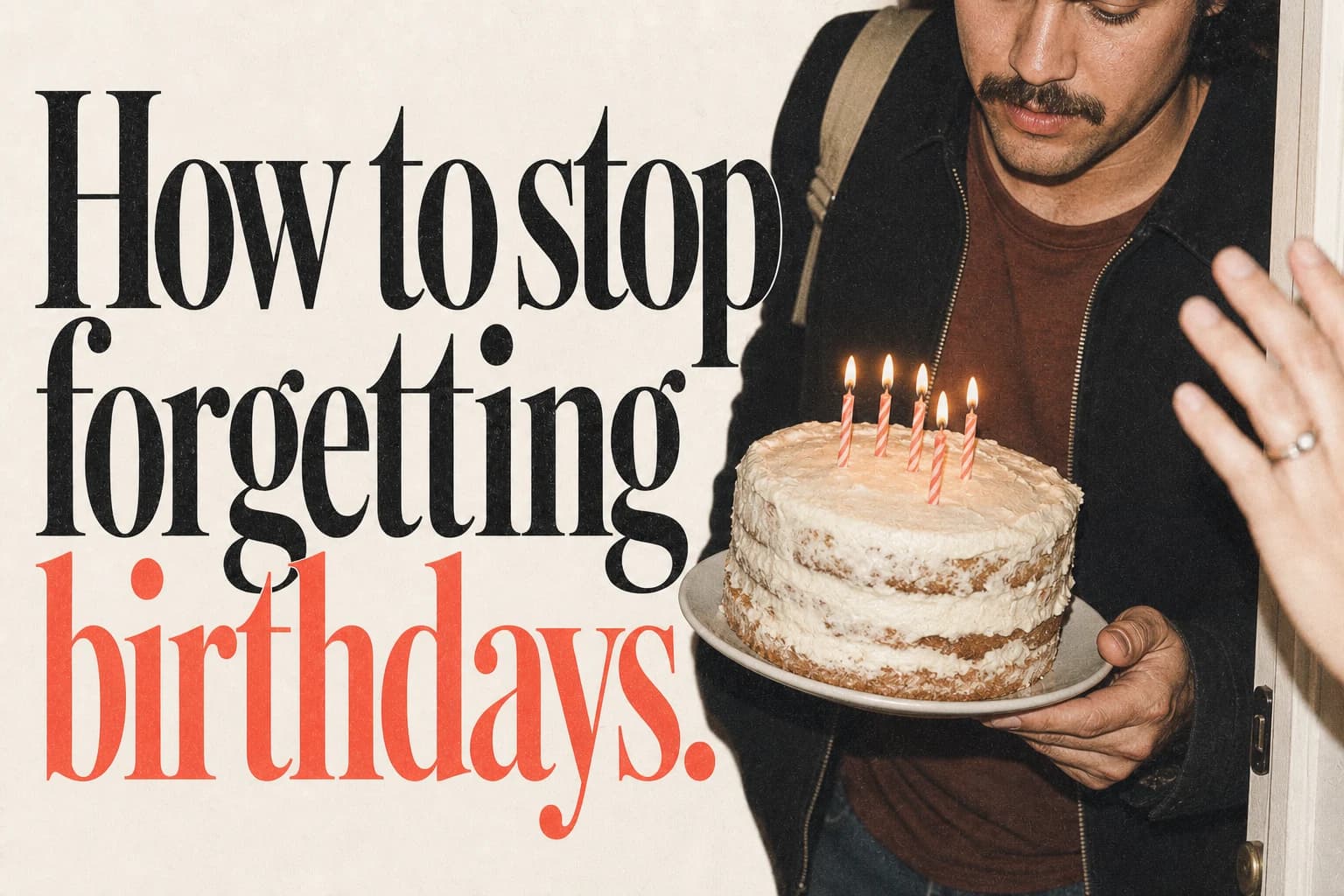
How to stop forgetting birthdays
Forgetting a birthday feels terrible out of all proportion to the actual crime. Nobody's day was ruined. And yet the guilt lands hard, because both of you know what it says: you weren't on my mind.
If it keeps happening to you, it's not because you don't care. It's because you're relying on your memory for something memory is bad at. Dates don't attach to feelings. You can love someone deeply and still have no idea what the date is today. Fixing this isn't a character project. It's a systems project, and the system takes ten minutes to set up.
Here's what works, what half works, and why most of it fails.
Why the usual fixes fail
Facebook and Instagram used to handle this for everyone, which is exactly why so many of us are helpless at it now. We outsourced birthdays to a feed, and the feed's price is your entire attention. If you're trying to spend less time on social media, or you've deleted it, the birthdays go dark with it. That's not a reason to stay. It's a reason to replace that one function properly.
Calendar reminders are the obvious answer and they half work. The failure mode is familiar: the notification fires on the day, at a useless moment, saying only "Sarah's birthday." You're in a meeting. You think "I'll message her tonight." Tonight arrives, the notification is buried, and you remember at 11:40pm. Or Thursday. The calendar remembered the date. It did nothing to produce the message, and the message was the whole point.
A spreadsheet or notebook works only for people who already review it weekly, which is to say: not the people reading an article called "how to stop forgetting birthdays."
What a system needs to actually work
Whatever tool you pick, four things separate the systems that work from the ones that decorate your phone:
1. Lead time, not day-of alerts. The useful reminder comes two or three days early, while there's still time to post a card, order something, or plan a call. A day-of alert turns a thoughtful gesture into a scrambled text.
2. It has to catch you at a moment you can act. A reminder that fires during your commute or your evening wind-down produces a message. One that fires mid-meeting produces guilt and a mental note that dies within the hour.
3. It should carry context, not just a name. "Sarah's birthday Thursday" is a fact. "Sarah's birthday Thursday, and she was mid house move last time you spoke" is the first line of a message. The difference between knowing a date and having something to say is the real barrier for most of us. It's why so many day-of reminders get dismissed instead of acted on.
4. It has to nag with dignity. If you don't act, a good system tries once more at a better moment, then lets it go. Systems that guilt you get muted within a month, and a muted system protects nobody's birthday.
The ten minute setup (do this today)
- Write down your inner circle. The ten to twenty people whose birthdays genuinely matter to you. Not your whole contact list. The list being short is what makes it work.
- Collect the dates you know. For the ones you don't, just ask. "When's your birthday? I'm terrible with dates and I'm fixing it" is a message people are always happy to get.
- Put every date into your system of choice with the reminder set 3 days early, at a time of day you're actually free.
- When the reminder fires, send the message then. Not a mental note. The entire system exists to convert the reminder into a sent message while the window is open.
Do only this, with a plain calendar, and you'll already beat 90% of people.
Where this breaks down, and what I built instead
The calendar version has a ceiling. You have to maintain it, it knows nothing but dates, and it can't help you with what to say. Every birthday still arrives without context. And everything else that keeps relationships alive, the follow-up on her surgery, the call you promised when the baby came, has no date at all, so no calendar will ever save it.
That ceiling is why I built Companion. It's a private companion that lives in Telegram. You tell it about your people, by voice note, in normal sentences. "It's Dana's birthday on the 14th and she just started the new job." It remembers all of it. When the moment comes, it nudges you with the context that makes the message easy, helps you find the words if you want, and gets out of the way. It never messages anyone for you, and it's not another feed to check. It speaks up only when there's a reason.
The calendar remembers dates. The point was never the dates. It's that the people you love hear from you.
Common questions
Frequently asked questions
What is the best way to stop forgetting birthdays?
Write down the birthdays that matter and set each reminder two or three days early. Choose a time when you can act, then send the message when the reminder arrives.
Why don't calendar birthday reminders work?
A day-of alert often arrives at a useless moment and carries no context. You dismiss it, plan to reply later, and lose it under newer notifications.
When should I set a birthday reminder?
Set it two or three days before the birthday. That leaves time for a card, a gift, or a planned call instead of a rushed text.
How can I remember birthdays without social media?
Keep a short list of the people whose birthdays matter and put those dates in a calendar or another external system. The system needs lead time, useful timing, and context.